Tracing the Roots of Thanksgiving in Canada and Mississauga
/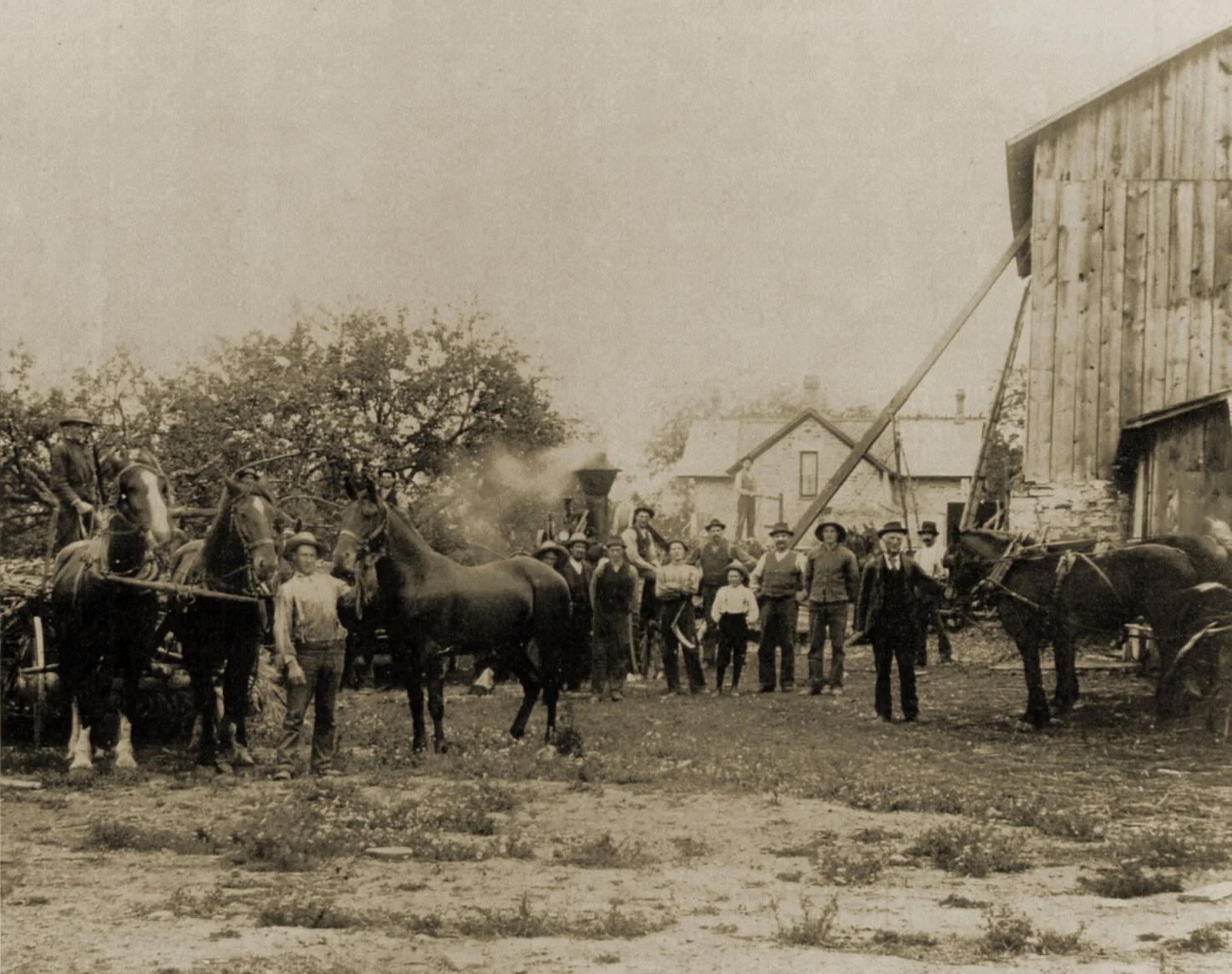
Harvest gathering, Adamson Farm, near Erindale, c1900
Thanksgiving is traditionally a time of gathering and gratitude, but have you ever wondered about the historic origins of the holiday? Have you ever been curious about why the different time of year between Canadian and American Thanksgiving?
Here in Canada, many will spend the Thanksgiving weekend raking leaves, harvesting apples and pumpkins, and enjoying the last of the fall colours. It is also often a time gathering with family and friends to enjoy a festive meal. For many, the long weekend marks the transition between the autumn warmth and the coming of the cooler weather. Yet many of the traditions associated with Thanksgiving have roots that long predate the European settlement in North America.
Long before colonization, Indigenous peoples had seasonal observances and ritual communal feasts associated with fall harvests, along with dance, potlatch and other spiritual ceremonies. For many Indigenous cultures, autumn was celebrated as a sacred time to give thanks and prepare for winter through the gathering fall berries, fishing, hunting, and storing food. Autumn not only marked a change in the weather but was an important spiritual reminder of the natural cycle of life.
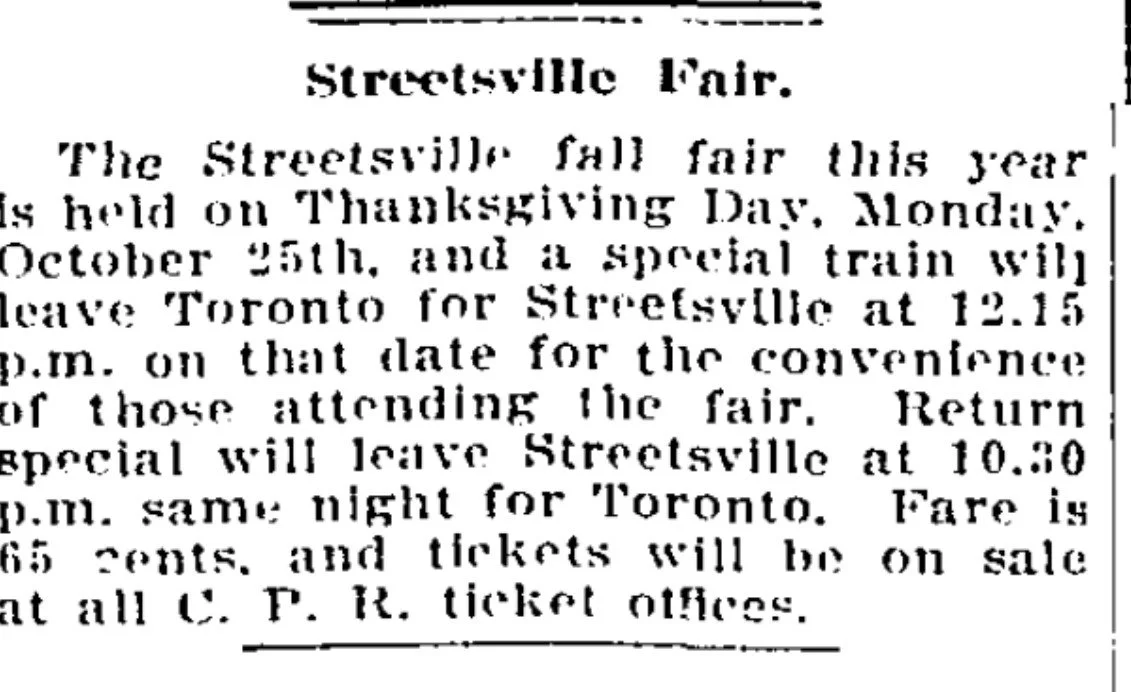
From The Globe, October 22, 1909
Early colonial settlers also brought harvest traditions with them, many of which can be traced back thousands of years. The origin of the horn of cornucopia symbolism, for example, can be traced back to ancient Greek and Roman cultures. Think about that the next time you see front porch displays spilling over with pumpkins, gourds and the like.
The first recognized Thanksgiving observance by Europeans in North America is believed to have been held by Martin Frobisher and his crew in what is now Nunavut in 1578 after an unsuccessful attempt to find the Northwest Passage. Their documented meal of Thanksgiving featured salted beef, biscuits and mushy peas. The next known observance of the Thanksgiving tradition in North America was conducted during the Pilgrims’ first fall harvest in Massachusetts in 1621, inspired by equal measures of religious observance, relief on having arrived in North America, and for bringing in the harvest to help see them through the coming winter.
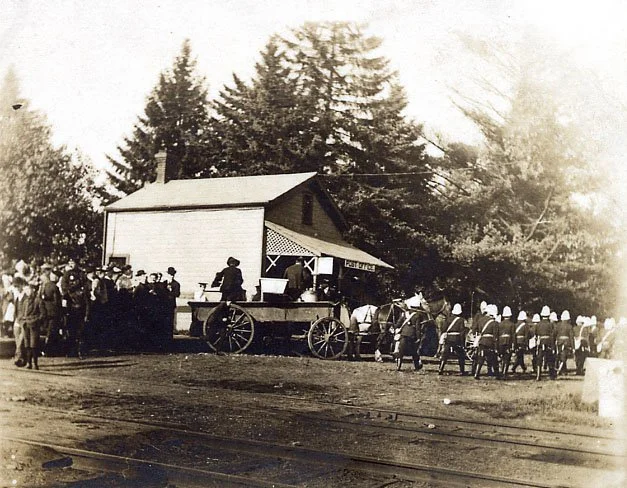
Thanksgiving Parade, October 18, 1906, Clarkson, MLS
Thanksgiving observances are found in Nova Scotia in the 1750s, with a formal day of “Thanksgiving” commemorating the end of the Seven Years’ War in 1763. These early Thanksgiving traditions in featured uniquely North American staples: turkey, squash and pumpkin. Originating in the United States, these culinary connections found their way into Canada by the 1770s. In these early years, the observance of Thanksgiving was directly connected to religious ideals, as the day was intended for the “public and solemn recognition of God’s mercies.”
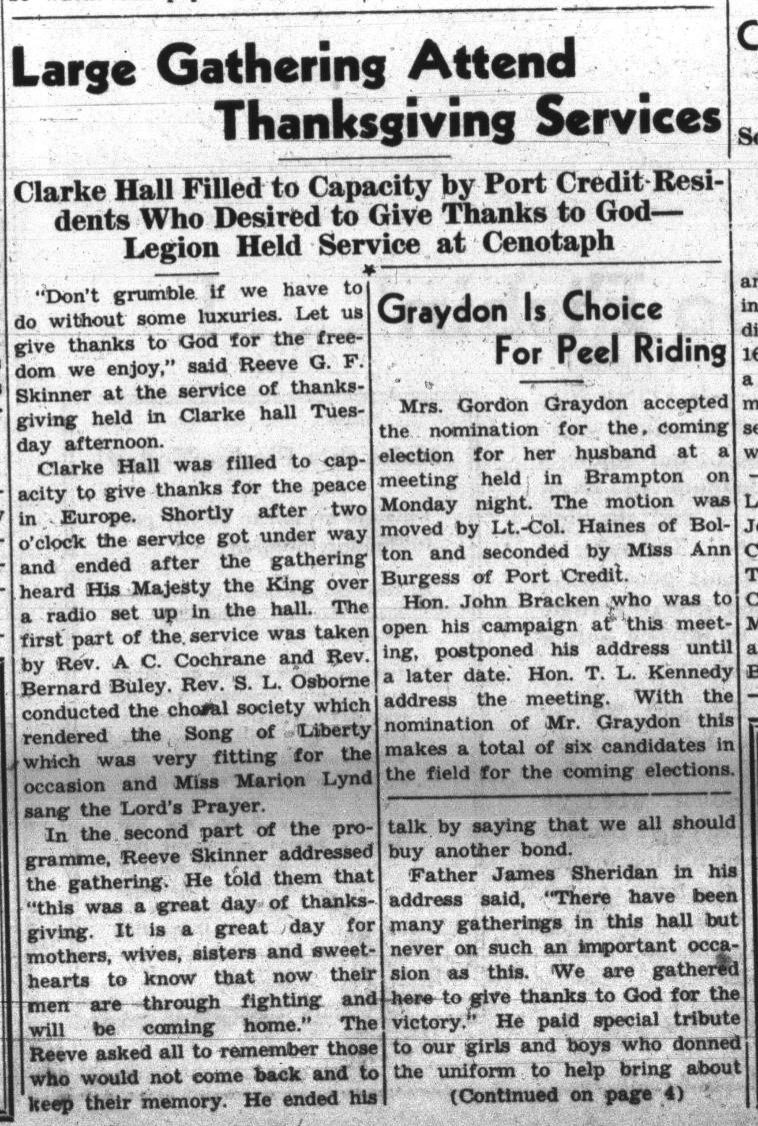
From Port Credit Weekly, November 8, 1945
Before Confederation, Thanksgiving in Canada did not have a fixed date and could vary from region to region, and from year to year. The first Thanksgiving after Confederation was formally observed on April 5, 1872 as a national civic holiday, rather than a religious one, and was held to celebrate the recovery of the Prince of Wales (later King Edward VII) from an illness.
While Thanksgiving today has evolved into more of a secular tradition for many Canadians, there is no denying its origin as a religious observation. In the wake of the Fenian Raids, Confederation, and the Northwest Rebellions, many saw Thanksgiving as a tool of Nation-building, Canadian patriotism, and promoting Christianity.
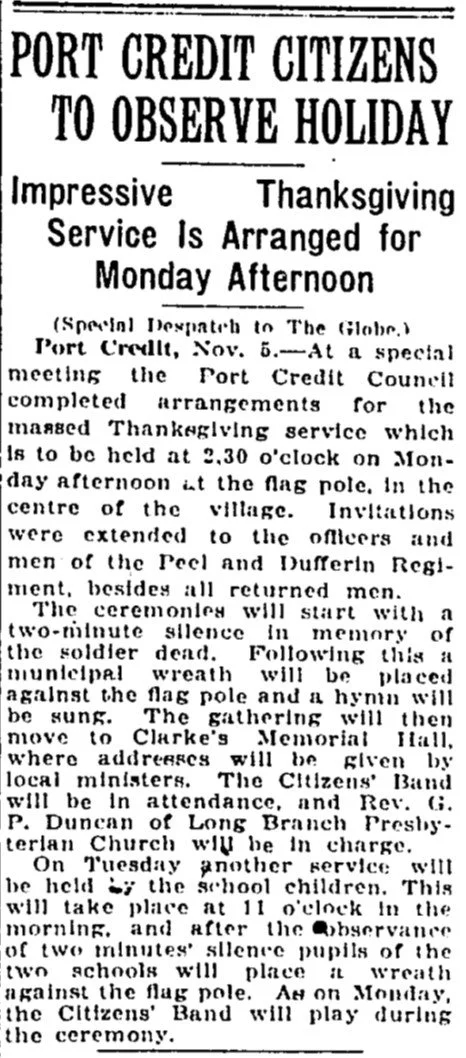
From The Globe, November 6, 1924
Thanksgiving was first observed as a formal, federal holiday in Canada on November 6, 1879 and “the date for each of the following years, as well as a unifying theme for which to give thanks (usually concerning the harvest, though anniversaries related to the British monarchy were also common), was determined annually by Parliament.” In 1890, Thanksgiving was linked to Decoration Day (June 2), honouring the Battle of Ridgeway. In 1910, Thanksgiving was observed on October 31, connecting it, at least for one year, with Hallowe’en. Thanksgiving did not have a fixed day or time of year for quite some time, being observed some years in December, and other years coinciding with American Thanksgiving in late November.
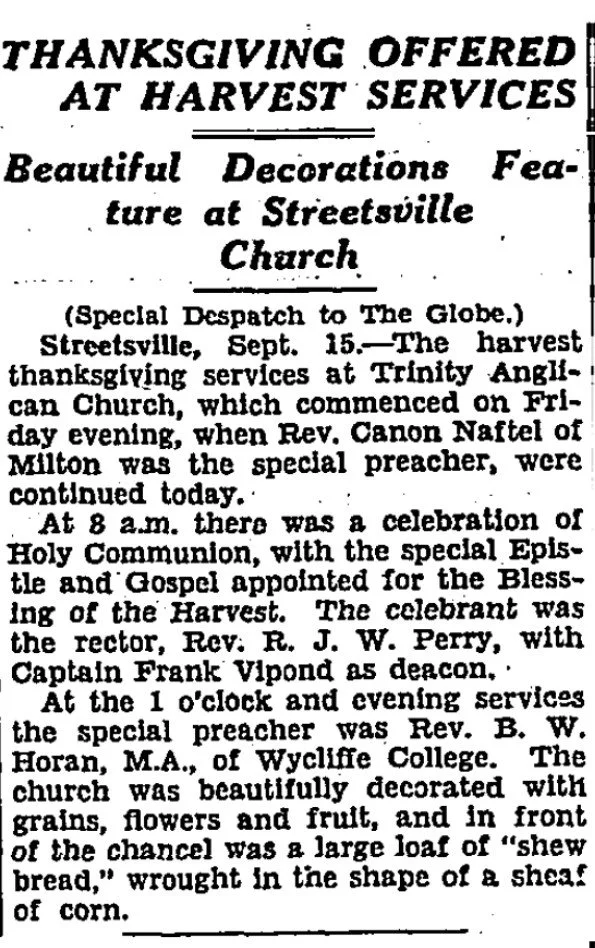
From The Globe, September 16, 1929
The Canadian federal government introduced the Thanksgiving Act in 1921 which established the date for Thanksgiving as the first Monday of the week of November 11, coinciding with Armistice Day observances. In 1931, Remembrance Day was formally adopted as November 11, and the Thanksgiving Act was amended to once again allow Thanksgiving to be proclaimed annually, but typically marking the day between the second, third and forth Mondays in October. Part of the reason for the move into October was to allow for sporting activities and outdoor festivities in slightly warmer weather. It was not until January 31, 1957 that Parliament proclaimed that Thanksgiving would be observed on the second Monday in October – a tradition that continues today.
Looking back through historic newspapers for early references to Thanksgiving here in historic Mississauga showcases some of the local activities associated with the holiday. Between 1894 and 1914, the Toronto Township Fall Fair in Cooksville and the Streetsville Fall Fair were linked to Thanksgiving. School and veterans’ parades were also common observances, including parade referenced as taking place in Clarkson, Cooksville, Port Credit and Streetsville. Thanksgiving was also marked with matinee theatre performances, public speaking, and musical entertainment. Special church services also took place across historic Mississauga. In 1929 Trinity Anglican Church in Streetsville was mentioned for its beautiful decorations and special harvest service.
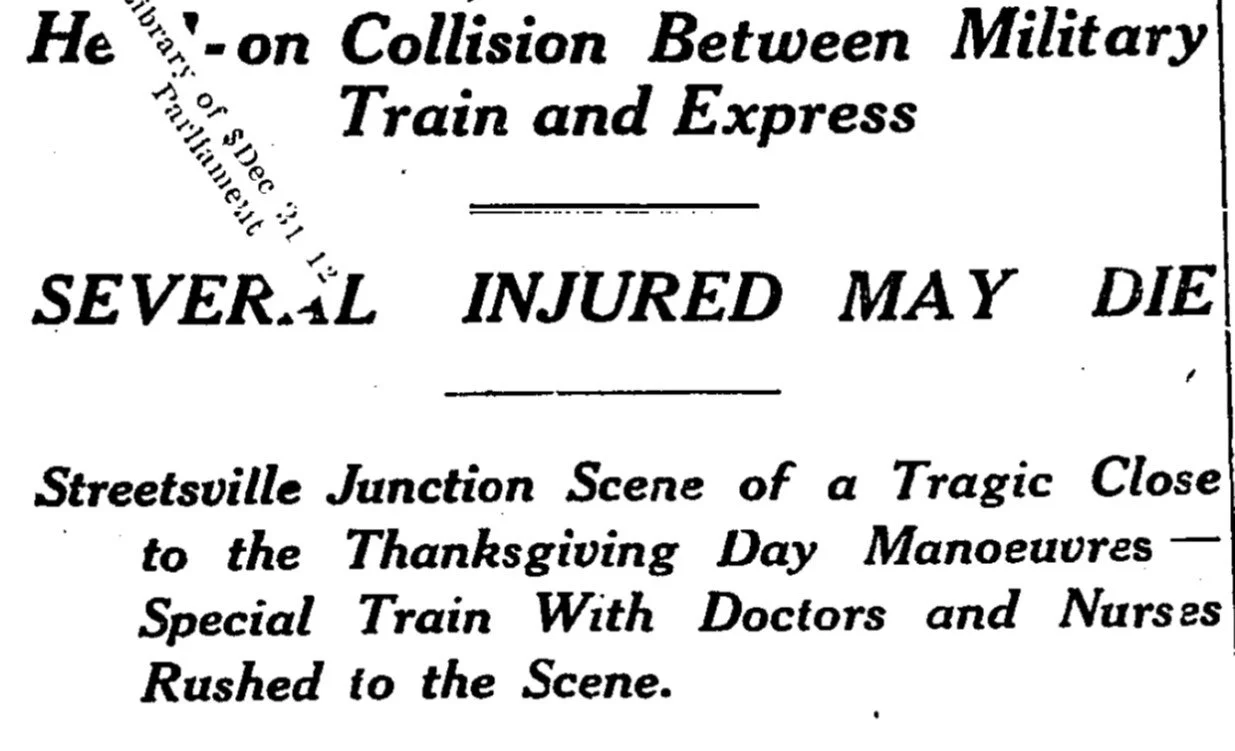
From The Globe, October 29, 1912
A dark chapter to our Thanksgiving observances occurred on Thanksgiving evening, October 28, 1912, with a train collision in Streetsville. Sadly, the accident claimed the lives of two militia members from the 48th Highlanders, Private John Bannatyne and Private Maxwell Murdock, who were travelling home after taking part in military exercises. The accident injured more than 30 and cast an understandable pall over the evening’s intended festivities.
In Erindale in 1928, the newly built Erindale Community Hall hosted a Thanksgiving evening featuring theatre, music, and school performances. The Hall was a focal point for local Thanksgiving activities for a number of years afterwards.
In recent years, many Canadians have begun reflecting more deeply on what Thanksgiving represents and how we can decolonize the holiday. ‘Decolonizing Thanksgiving’ invites us to recognize the Indigenous histories, experiences, and ongoing stewardship of this land that predate European settlement. It is about moving beyond a single narrative of “pilgrims and pioneers” to include the voices and traditions of Indigenous Peoples whose fall harvest celebrations long preceded colonial observances.
Simple actions, such as: 1) learning about the Mississaugas of the Credit First Nation, 2) acknowledging the land, 3) supporting Indigenous-led initiatives, or 4) incorporating traditional foods and teachings into your gathering, can make this day even more meaningful.
From all of us at Heritage Mississauga, we extend our best wishes to all during this Thanksgiving season, as we reflect and cherish the moments, stories and bonds that unite us.